What Makes a Great Teacher?

This week I saw an awesome article from the Washington Post that made me think of all the awesome teachers we have here at school.  It was about Ellie Herman and some lessons she has learned.  Ellie worked for 20 years as an American television writer. She worked on some small shows you may have heard of:  Doogie Howser, M.D., Melrose Place, and Desperate Housewives among others.  However, in 2007 she decided to become an English teacher and took a job working in a very different school environment than ours, one where 96% of the students are living below the poverty line in South Los Angeles, California.  In 2013, Ellie stopped teaching and started observing other teachers to try and learn from them.  She also started writing about what she was observing and learning; it is phenomenal stuff.

Ellie is a fantastic writer (as one could assume) and easy to read.  I want to say this as clearly as possible:  If you have never bothered to read something I’ve shared, let this be your first…it’s great.

Once you’ve read that post go ahead and explore some more…start with the front page or this article about why “love is the answer”.

If you need convincing, here are five practices Ellie observed in great teachers (she explains these in her post):

1.  Great teachers listen to their students.

2.  Great teachers have an authentic vision for their students.

3.  Great teachers have an unequivocal belief in all students’ potential.

4.  Great teachers are calm, persistent pushers.

5.  Great teachers practice non-attachment to short-term results.

These aren’t new ideas, they’re not even ground-breaking.  They are good reminders though and the way Ellie describes these traits is very energizing.  I’m most emotionally attached to numbers three and four as you may have guessed, I love to keep pushing (sometimes pulling/dragging) those kids who need the extra support because I very strongly believe in all students’ potential.  I also can’t help but notice how this all keeps coming back to the Mindset conversation 🙂

Inspiration from Harvard Graduate School of Education

This week I had a whole other topic written out and then I came across some great stuff.  I was reading through a few of my older Marshall Memos when I stumbled upon some awesome videos.  If you follow this link you can see Eight 8-minute talks about education from the Harvard Graduate School of Education:  http://www.gse.harvard.edu/news/14/09/8×8-hgse-faculty-share-their-bold-ideas-improve-education

I highly recommend any of the eight videos but these specific few may be more relevant to our context than the others.  Here are the relevant titles along with Kim Marshall’s brief summaries of each.  Do your students a favor and take 8 minutes to watch one of these (or more) videos.

Karen Brennan: Getting Unstuck – Helping students and teachers move beyond using social media and use computers more powerfully. Brennan describes using ScratchEd, a platform for creating projects, and students’ problem-solving strategies when they’re stuck.

Todd Rose: The End of Average (Bret’s personal favorite) – What neuroscientists have found about how differently people remember and process information, leading to the conclusion that we can’t understand individual brains by using group averages. The same goes for how we deal with students; we must treat them as individuals, which we now can do better with recent advances in classroom technology.

Karen Mapp: Linking Family Engagement to Learning – Relationships between schools and families have to be relational, interactive, collaborative, developmental, and linked to what students are learning, says Mapp, so that families can be more effective supporting learning at home. In particular, Mapp is critical of traditional open-house meetings in schools.

Howard Gardner: Beyond Wit and Grit  – Our understanding of “wit” has been expanded to include multiple intelligences, says Gardner, and we now realize the importance of “grit” – the cluster of non-cognitive skills. But these are not enough. Gardner believes we also need a moral dimension. “You can have plenty of grit, and multiple wits,” he says, “but they need to be directed towards becoming a good person, a good worker, and a good citizen… There’s a ‘triple helix’ of good work and good citizenship: excellence, ethics, and engagement.”

Building Positive Student-Teacher Relationships

This week we finally got to one of my favorite initiatives at SCIS, our SIPs program.  The opportunity to work with colleagues and grow as educators is an energizing and inspiring experience for me.  Our SIPs plan this year has been designed to focus on our six major “look fors” as well as help to integrate technology into our classrooms.  This past Wednesday I was fortunate enough to present with three of our brave colleagues.  I presented my SIP on Building and Fostering Positive Student-Teacher Relationships.  For those of you who were in the Google Sketchup session with Ross I’d like to share the general premise of what was happening across the hall…

As educators we are responsible for our students for more than 7 hours a day, five days a week.  We are the adults that have the most regular contact with these students, in almost every case they spend more time with us than with their parents.  They come to us during one of the most tumultuous periods of their lives and want nothing more than to be believed in, trusted, and cared about.  Middle School students want to fit in and they want to feel that they are important.  Last week when I visited classes as a student I was on the watch for “feeling like a nuisance” but I couldn’t find it…we already have a very good positive culture here at SCIS.  I, however, am a big Jim Collins fan and want to see us take our school “from good to great”.

I’ve been informed by a certain High School math teacher that my two cents “have turned into more like 8 cents” so I’m going to leave it at that for today but, as promised in my SIP, I am attaching a number of great links about building and fostering positive student-teacher relationships and classroom culture:

Two Cents of Happiness

Happy Friday and Happy October Holiday!!  In fact, we’re a pretty happy group around here these days 🙂  Not that it’s always perfect but, then again, when is life ever perfect?  I’ve been reading a lot about “The Science of Happiness” recently and while it’s been a personal interest for me it has also turned into a bit of a professional exploration as well.  A couple weeks ago I wrote about the impact we can all have by taking a positive outlook on things and I got a lot of great feedback from a number of people, thank you!  What I’d like to ask you to think about today is how all of that positivity adds up to make something (us) awesome.

Some of you will remember a few years ago back to when we started the COAR initiative, the one that lives on today on many of our shirts.  That was started for a very specific reason, to build the positive culture here on our campus.  At the time there was a lot of focus on negativity and, even though it was a relatively small element, it was getting a lot of attention.  What we aimed to do was drown out the negative with an overwhelming sense of positivity and, I believe, we’ve done that.  That’s not to say that there is no longer negative but rather that we’ve done a much better job of focusing on the positives and enjoying the successes, of which there are many!

As I mentioned earlier, I’ve been reading a lot about the “The Science of Happiness” and I’ve been looking at some of the ground-breaking work done by Barbara Fredrickson, Ph.D. at the University of North Carolina Chapel Hill.  In 2005 she co-authored a paper that has become the ground work for a huge amount of theory behind positive thinking and living a positive lifestyle.  What I want to focus on today though, is what Fredrickson considers the “tipping point” between flourishing and withering.  Throughout her work, Fredrickson and her co-author Marcel Losada came to the conclusion that if you live your life with three positive emotions for every one negative emotion then you will have a remarkably high likelihood of flourishing in life.  I couldn’t help but take this “positivity ratio” and apply it to our Middle School.

The amazing thing that I see when I start thinking about our Middle School and all the awesome stuff that happens here is that we’re way beyond a 3-to-1 ratio here.  Our positive emotions outweigh our negative emotions, not just by three but by multiples of three!  Our Middle School celebrates awesomeness, our students ooze it, and our teachers are models of positivity.  Keep in mind, this 3:1 ratio was identified from research based on individuals but it only makes sense that this (or at least a similar) ratio could also apply to schools and other organizations.  From all of the reading that I’ve done, there are a lot of people who struggle to meet this ratio in their personal lives but, fortunately for me, I don’t believe that I work with many of them!  Nope, our Middle School is flourishing and it’s because of you!!!

Enjoy your October break everybody and travel safely!!!

http://greatergood.berkeley.edu/article/item/are_you_getting_enough_positivity_in_your_diet (Are you Getting Enough Positivity in Your Diet by Barbara Fredrickson)

http://www.theguardian.com/science/2014/jan/19/mathematics-of-happiness-debunked-nick-brown (To give fair billing, Fredrickson’s math has been challenged in recent years)

http://www.unc.edu/peplab/publications/Fredrickson%202013%20Updated%20Thinking.pdf (BUT, Fredrickson stands behind her research)

And in case you’d rather just dance with almost 500 Million other people http://www.youtube.com/watch?v=y6Sxv-sUYtM

The (Growth) Mindset of a Teacher

Over the last couple weeks we’ve been getting all of our students through their first round of MAP tests, much to their dismay!  I was covering in a few of these classes and tried having a conversation with them about the idea of growth and celebrating just how far they’ve come at the end of the year; it seems like this whole concept just washes over them like a huge wave of “whatever Mr. Olson!”  I, however, take solace in the things I heard kids saying at the end of last school year.  As we finished up the MAP testing in late May I heard all sorts of conversations between kids, with me, with teachers, and with parents about the amount of growth they had made over the course of the year.  The mentality of our students has started to make a promising shift toward a growth mindset, especially for the kids who saw a significant amount of growth!  It was an awesome feeling to hear those kids talking (and bragging) that way.

We’ve talked a lot about growth mindsets, especially when we read Mindset by Carol Dweck, and we all buy into this theory for our kids.  There is great work being done by curriculum teams to plan differentiated work, for not only struggling students, but also for more advanced students who need a bit of challenge.  We all know that every student CAN learn when we meet them at their level; growth can and will happen!  We are working hard to ensure that every student has the chance to learn, whether today, tomorrow, or some time down the road.

Another reason that got me thinking about this idea of growth is our recent addition of the mini-observations and the coinciding feedback efforts.  I’ve had some awesome conversations with you based around what’s happening in your classrooms.  For me, some of the most rewarding parts of this process have been the conversations we’ve been able to have about the student-learning that we’re seeing.  To hear the excitement in your voices when you talk about the amazing things you’re seeing and doing with your students is energizing for me.  Coming back to the growth piece of this, it’s awesome to see all of the additions and changes that people have been making based on our conversations.  Good teachers are made from hard work, practice, and continuous learning.  Teachers don’t just fall off of trees, it takes a lot of effort to become a great teacher.   To see everyone working so hard to improve themselves on a day-to-day basis is inspiring…awesome!!

I’m attaching a great article summary to this email about five things that great teachers do to have an impact on student-learning.  The summary comes from the Marshall Memo, which is written by Kim Marshall.  It’s a great resource that comes out each week summarizing important topics in educational research and practice.

Make it a Great Day

Make it a great day…I’ve certainly received a lot of comments about that phrase over the years!  I started using this as a way to close my emails a little more than five years ago, shortly after my father started using it.  I’m not 100% sure where he originally came across the idea but I know it came out of some research he had been doing about positive mindsets.  I spoke with him about it at length and eventually asked for permission to use it myself, I love it.

To me the mindset change from the usual “have a great day” to actually “making” it great is really a life-changing shift. The more conventional version is a nice sounding idea, I mean who wouldn’t like to ‘have’ a great day?!?  However, the problem here is that merely “having” a great day is a passive act, it implies that the person involved really has no control; we might as well say “good luck with your day!”  BUT, if we change this just ever so slightly the implication becomes a mindset shift of epic proportions.  “Make it a great day” implies that this day is yours for the taking, you can make it whatever you’d like.  How you approach each situation, each interaction, will impact how your day goes.  You don’t need to sit back and cross your fingers that today is going to be great, you can go out and take control of the day and make it great!

Not only can you influence how your day is going to go based on how you approach it but you can very easily change the direction of anyone’s (especially a student’s) day with the way you approach them. There is lots of research that shows that students who receive more positive interactions throughout the day do better in everything.  They show increased academic results, better decision making ability, less behavior problems, more positive interactions with their peers, higher self-worth, and an overall higher level of happiness.  It’s amazing how much of an impact one person can have on those around them, especially if it is a teacher in a classroom full of middle school students!!

We have an extremely positive atmosphere here at SCIS and you (our teachers) play a HUGE part in that.  A few weeks ago I attached a video about the Science of Happiness and a number of you wrote to me with some great feedback.  This week I’ll attach a couple good articles about the impact of positive interactions with students that include some great examples of how to build those relationships.

http://www.jongordon.com/blog/the-power-of-positive-interactions/

http://www.interventioncentral.org/behavioral-interventions/motivation/motivation-challenge-6-student-lacks-positive-relationship-teach

http://www.ascd.org/publications/books/105124/chapters/Developing_Positive_Teacher-Student_Relations.aspx

Enjoy your weekend and of course…

Make it a great day,

Bret Olson

How Do You Define Success?

We’ve had a very successful start to the school year and that is what I want to encourage you to think about today, success.  Take a second to stop and ask yourself one question, “what is my definition of success?”  Seriously, stop and think about that for a minute or two…

Okay, now that you’ve taken a second to think about your definition I want you to consider all the other potential definitions of success that are out there.  Think about what a successful school year would look like for the students in your classroom.  I am confident that for all of you there is already a pretty clear vision of what a successful year in your class will look like for your students.  After all, you’ve planned collaboratively, considered what’s most important, created unit plans, designed labs, and done all sorts of other work to make sure that your students will have a successful year with you.

However, as seems to be more and more of a common theme for me, I want you to consider yourself.  What would a successful year look like for you as a teacher?  It’s important to reflect on your teaching practices and your professional experiences.  Think about areas where YOUR growth could lead to even more opportunity for success with your students.

This past summer I took a course through the Principal’s Training Center (PTC) called “Instructional Supervision and Evaluation” because, as I’ve shared with everyone already, this is my main focus for growth as a professional this school year.  It was an amazing opportunity to learn and collaborate with some of the international leaders in this area and I couldn’t have asked for more.  On top of that we have Kim Marshall coming in to work with the Leadership Team and I couldn’t be more excited to have such an amazing opportunity to grow and learn in this area.

As you continue on the path of excellence that you are all heading down already, what could help you grow as a teacher?  For some of you this process of self-reflection is old hat but for others this will be a new opportunity.  Embrace the chance to grow and improve every single day.  Think big and think small, set goals for the year and make every day better than the last!

A reminder of some of the PD resources available to you in this area:

·      EARCOS Weekend Workshops

·      ACAMIS

·      Sanguine Consulting

·      Chapters International

·      Scholastic U

·      Dragonfly Training

·      Knowledge Source Institute

·      Association of Middle Level Education

A good video to make you think about your definition of success:  https://www.youtube.com/watch?v=ulShj4keKNw (VPN needed)

Your Opportunity is Now

Tomorrow is new family orientation and it will be the first day that we’ll officially have kids on campus, so exciting! I know we’ve been back to business for almost a week now but the time seems to have flown by as we’ve hit the ground running and we’re ready for a new year. The sheer amount of opportunities we have before us this school year is tremendous and it sets my mind racing just to think about it. Whether you’re new to teaching, new to SCIS, or you’ve been here long enough to be considered a Golden Dragon the opportunities for you are incredible.

Those of you who are just getting started in your time at SCIS come from a variety of backgrounds; some of you are veteran international schoolteachers and others are just embarking on what could be a lifetime in this small world that we call the international education community. Some of you have been around the world and will be making your first stay in Asia; enjoy it, explore it, and take in all that this amazing place has to offer. For those who are entering this nomadic life for the first time, welcome, you may never look back!

As new students and families begin to arrive over the next few days we all have the opportunity to make a first impression. The smiles and excited conversations we have with these new students will set the tone and help them feel at ease as they make a the transition into our community. A lot of times it’s the first happy face through the door that these kids remember ten years down the road; the person who helped them find their math class or who carried their uniform bag when the handles broke. It’s these small and seemingly mundane moments that often times define a student’s first, and lasting, memories of their new school. What an opportunity we have over the next few days!!

Our returning students will surely return with a mixture of emotions as well; some will be excited and others longing for the beach where they spent the summer. Opportunity lies within these students too. Seeing former teachers, meeting the new, and walking the halls where they’ve had so many great memories with their friends is sure to be exciting for our returning students. However, with those happy moments, come the not-so-happy memories of best friends and favorite teachers who’ve moved on to new schools and exciting adventures. The opportunity is yours to be their new inspiration, welcome them back and make them feel like they never want to leave again. Those smiles we see every morning as students get off the bus aren’t there because they love 7:30 AM, they happen because our students truly enjoy coming to SCIS each morning! Start building and strengthening your connections now and embrace the opportunity to inspire our students every single day.

Being our best every day for our kids and embracing the short-term opportunities before us will continue to make this the warm and welcoming school we’ve become. Let’s not forget about what I see as our greatest opportunity…the chance to reflect and continue down the growth process with two new leaders. As the year commences we begin down a long, and potentially winding, path toward the future. Over the last four years this Middle School has become a special place but the opportunity we have now is to push our school and ourselves forward to be even better. Challenge yourself to be better every day you wake up, every day you enter the classroom with students, every day you work with your colleagues; challenge yourself to be better, make it the best day yet, each and every day! Take the opportunity to be amazing!!


To the Virgins, To Make Much of Time

by Robert Herrick

Gather ye rosebuds while ye may,

Old time is still a-flying;

And this same flower that smiles today

Tomorrow will be dying.

The glorious lamp of heaven the sun,

The higher he’s a-getting,

The sooner will his race be run,

And nearer he’s to setting.

That age is best which is the first,

When youth and blood are warmer;

But being spent, the worse, and worst

Times still succeed the former.

Then be not coy, but use your time,

And, while ye may, go marry;

For, having lost but once your prime,

You may forever tarry.

Mr. John Keating – Dead Poets Society – encourages you to seize the day!

https://www.youtube.com/watch?v=veYR3ZC9wMQ (VPN required)
Pushing Our Limits

Last weekend our Outdoor Education group went for their weekend adventure which included hiking 12k in constant rain, battling leeches, and a midnight visit from two local bulls having a fight right in the middle of the campsite.  On Monday morning there was nothing but smiles and happy stories from the 20+ exhausted kids who enjoyed this experience.  The parent reaction was just the same, nothing but positive feedback despite a myriad of potential complaints.  This coming week we head out on our China Trips with all but a small handful of our middle school students and teachers.  For some this will be their first time away from their parents for so long, their first time camping, their first time kayaking, or any other number of potential firsts.  This coming week our students will have their limits pushed in many ways, they’ll be challenged, there will be tears, breakdowns, and home sickness.  BUT, at the end of it all, no matter what challenges these students face they will persevere and come back with smiles and happy stories to accompany their tales of overcoming fears and challenges.  I know that for us as teachers this is also a week full of challenges and stress, with perhaps a few activities or meals that will push us out of our comfort zones.  Take the opportunity to push your limits, try something new, get to know students in a different setting, and have fun!!  Enjoy the coming week, it’s my favorite week of the year!

Ready-to-Use Tools: Strategies for Working with Challenging Students

Nothing is more valuable than a teacher’s time and energy! Often times those precious resources get monopolized by a few challenging students while the other students in a class are left to fend for themselves. Our students are no different than the rest of the population; some require more time and effort than others. Personally, it’s the challenging students that excite me and drive my love for working in education. Ever since my first days as a teacher I’ve had a soft spot for the kids that others may see as a bit “crazy” or high-maintenance. I don’t disagree that difficult students can be frustrating and tiring but I also embrace the challenges that accompany these students and enjoy the roller coaster ride of emotions that comes with the task.

Realizing that not everyone agrees with my opinions, I thought it would be beneficial to provide some suggestions and strategies for working with this brand of student:

  1. Build the Personal Connection:

This is often the hardest thing to do with students who are the biggest challenge, not because it’s a difficult task but because it requires so much patience for a student who is already taking a lot of your time and effort. However, the dedicated attempts to build a relationship with these students will pay off many times over once that connection is established. Try some of these easy ideas:

    1. Meet your students at the door with a handshake, high-five, fist-bump, and a friendly smile each and every class period while welcoming them to class. (Also recommended: An entrance procedure and a regular beginning of class routine for students to enter into once they’ve been greeted.)
    2. Ask your students questions about themselves! Simple questions about their weekend will lead to information about their interests. Remember their interests; keep written notes if necessary and follow up with more conversation in the future.
    3. Get out and support them. There’s no better way to show a kid that you’re in their corner than by showing up on the sidelines, backstage, or front row at their performances, games, etc.
    4. Make positive contacts with the parents. Call, e-mail, or meet them in person; do this early and often. If a student has recently become a challenge, balance the bad with good. Parents who only see/hear negative messages about their little angels will be the first to turn against you.
  1. Watch Your Language:

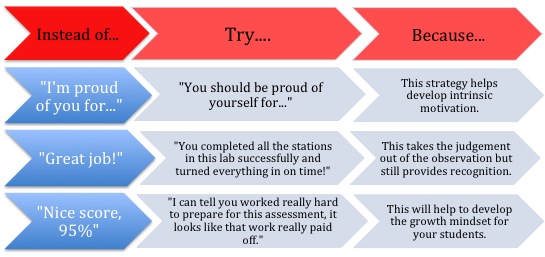
How you talk to your students matters; that much is obvious. At times, it’s not just the tone, the words, or even the message that is the most important. Motivation and mindset are huge pieces of helping to build a child’s self-esteem. You’re not always going to be there to support this student as they move through life; it needs to be something they can do on their own. Intrinsic motivation and the understanding that hard work and effort can and will pay off are especially crucial for your most challenging cases. Often times it’s the toughest kids who have the lowest self-esteem. Help them build their self-worth by beginning to watch your language:

Challenging Students

  1. Be Proactive and Create Success

Often times our communication of satisfaction can be vague and brief. It is important to point out exactly what behavior you are noticing without judgment. When a challenging student cleans his art supplies as you have requested, a simple “thank you” is too general and broad to have a lasting impact. Instead, let the student know you’ve noticed by saying, “You cleaned all of your brushes and your work station is spotless!” This specific feedback gives no judgment of the situation but it acknowledges that you’ve noticed and the student will know that they’ve been recognized. This strategy allows the teacher to slowly work past the defense mechanisms that challenging students build up to criticism. Keep at it and be consistent, students need to be recognized; they don’t need to be judged!

  1. Pay Them with the Right Energy

 Challenging students need attention, there is no question about that, but by focusing the timing and type of attention you can begin to foster more positive interactions with troublesome children. With difficult students we almost always give them negative attention immediately after they break the rules, thus reinforcing their behavior with energy. In order to promote success, and therefore a more positive approach, it is crucial to zero in on positives. With challenging students, focus on the behaviors that are non-negative. In other words, celebrate the smallest things even if they may seem like no big deal, especially at the beginning of this process when every little thing counts! Don’t wait around in an attempt to catch them doing well, create the success by instigating opportunities for success and celebrating anything possible.

 Challenging students often elicit an avoidance response from teachers when they aren’t acting out. It’s natural, a student takes up so much energy when they are off-task, then when they are actually behaving we revel in the freedom and tend to ignore them. Instead of avoiding a challenging student, focus on their non-negative behaviors and celebrate them. It won’t happen over night but over time these small successes will gather momentum and begin to pull that negative student up.

  1. Fill Your Emotional Bucket

 Challenging students are going to wear you down; it’s natural. Knowing that and keeping it in mind is crucial to success with difficult students. Our students aren’t like significant others who we can break up with and move away from if we don’t get along, working together with challenging students is essential. Reflect on your successes with these students, celebrate them, and enjoy the positive moments as much as possible. You’ll see growth and you’ll see progress and it will make your day when you do! However, just like Dr. Seuss has taught us, you’ll have you’re slumps and so will your students. There will be days when that challenging student who seemed to have turned a huge corner has a hiccup and reverts back to their old habits. It will be tough but in those times it is more crucial than ever that you are patient and understanding. No one, even challenging students, forgets who was there for them during the hard times and on the bad days!!

We work in a job that often times feels thankless; it’s not easy to do these things when you feel under appreciated. Know this — you are appreciated and loved! Perhaps your students don’t have the social-emotional abilities to communicate their appreciation to you but they love you! Look for it in small places: Their growth in your subject, the way they smile as they enter your classroom, the small and sometimes weird things they noticed about you (Did you get new shoes? You cut your hair! Why do you drink coffee from the same mug every day?) and for us middle school people, just the acknowledgement that you exist is sometimes a huge sign of respect and appreciation!

Everyday we come to work ready for a new adventure, we know the toils and challenges of being a teacher and understand the benefits that come with our role. Challenging students are an inevitability of our job. They’re the “crazy” ones, they’re the ones that make me love coming to work every day, and they’re the geniuses!!