Last weekend our Outdoor Education group went for their weekend adventure which included hiking 12k in constant rain, battling leeches, and a midnight visit from two local bulls having a fight right in the middle of the campsite. On Monday morning there was nothing but smiles and happy stories from the 20+ exhausted kids who enjoyed this experience. The parent reaction was just the same, nothing but positive feedback despite a myriad of potential complaints. This coming week we head out on our China Trips with all but a small handful of our middle school students and teachers. For some this will be their first time away from their parents for so long, their first time camping, their first time kayaking, or any other number of potential firsts. This coming week our students will have their limits pushed in many ways, they’ll be challenged, there will be tears, breakdowns, and home sickness. BUT, at the end of it all, no matter what challenges these students face they will persevere and come back with smiles and happy stories to accompany their tales of overcoming fears and challenges. I know that for us as teachers this is also a week full of challenges and stress, with perhaps a few activities or meals that will push us out of our comfort zones. Take the opportunity to push your limits, try something new, get to know students in a different setting, and have fun!! Enjoy the coming week, it’s my favorite week of the year!
Author: Bret Olson
Leave the Locker Room Smell but Bring the Coaching
I often think of the start of my teaching career as the first time I stepped into a classroom full of kids, or perhaps on the first day of PD, or maybe even at the beginning of my teacher training. However, a piece I read recently got me thinking that perhaps I had started my teaching career much sooner than I had even realized.
Craig Owens is an associate professor in the English department at Drake University and openly admits that he is “no sports enthusiast.” Which makes his commentary piece even more interesting. See, he was asked to be an “honorary coach” at one of the university’s home basketball games and he noticed something. He realized that the interactions in the locker room (between players and coaches; players and players; coaches and coaches) were almost exactly the sort of engagement that teachers strive for (or should strive for) in the classroom. Despite having a self-proclaimed “robust (classroom), with participants reliably raising their hands to answer questions or offer insights.” Owens noticed something in that locker room that he felt was missing from his classes, authentic learning.
This got me thinking, back to when I started out as a youth basketball coach during my sophomore year of high school. Okay, it wasn’t college level hoops (I got to that later!) but I had to wonder if that was where this all started for me. Then I started thinking about us as a staff and all the coaches, dive instructors, directors, and conductors we have as part of this awesome team. Now, my challenge for you…think about how your classroom can look more like the locker room, if you’re not a coach then go and watch some high school practices or talk with your colleagues who have paced the sidelines. Some of the greatest coaches have been successful because they were also great teachers. I think it’s time to start thinking of teachers as coaches and not just the other way around…that’s my two cents, what do you think?
Ready-to-Use Tools: Strategies for Working with Challenging Students
Nothing is more valuable than a teacher’s time and energy! Often times those precious resources get monopolized by a few challenging students while the other students in a class are left to fend for themselves. Our students are no different than the rest of the population; some require more time and effort than others. Personally, it’s the challenging students that excite me and drive my love for working in education. Ever since my first days as a teacher I’ve had a soft spot for the kids that others may see as a bit “crazy” or high-maintenance. I don’t disagree that difficult students can be frustrating and tiring but I also embrace the challenges that accompany these students and enjoy the roller coaster ride of emotions that comes with the task.
Realizing that not everyone agrees with my opinions, I thought it would be beneficial to provide some suggestions and strategies for working with this brand of student:
- Build the Personal Connection:
This is often the hardest thing to do with students who are the biggest challenge, not because it’s a difficult task but because it requires so much patience for a student who is already taking a lot of your time and effort. However, the dedicated attempts to build a relationship with these students will pay off many times over once that connection is established. Try some of these easy ideas:
- Meet your students at the door with a handshake, high-five, fist-bump, and a friendly smile each and every class period while welcoming them to class. (Also recommended: An entrance procedure and a regular beginning of class routine for students to enter into once they’ve been greeted.)
- Ask your students questions about themselves! Simple questions about their weekend will lead to information about their interests. Remember their interests; keep written notes if necessary and follow up with more conversation in the future.
- Get out and support them. There’s no better way to show a kid that you’re in their corner than by showing up on the sidelines, backstage, or front row at their performances, games, etc.
- Make positive contacts with the parents. Call, e-mail, or meet them in person; do this early and often. If a student has recently become a challenge, balance the bad with good. Parents who only see/hear negative messages about their little angels will be the first to turn against you.
- Watch Your Language:
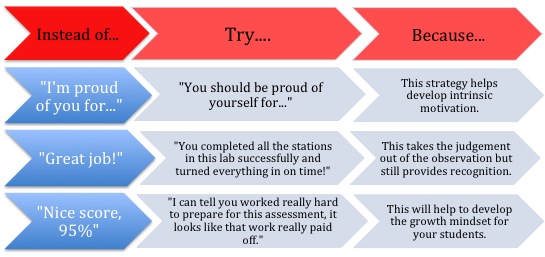
How you talk to your students matters; that much is obvious. At times, it’s not just the tone, the words, or even the message that is the most important. Motivation and mindset are huge pieces of helping to build a child’s self-esteem. You’re not always going to be there to support this student as they move through life; it needs to be something they can do on their own. Intrinsic motivation and the understanding that hard work and effort can and will pay off are especially crucial for your most challenging cases. Often times it’s the toughest kids who have the lowest self-esteem. Help them build their self-worth by beginning to watch your language:
- Be Proactive and Create Success
Often times our communication of satisfaction can be vague and brief. It is important to point out exactly what behavior you are noticing without judgment. When a challenging student cleans his art supplies as you have requested, a simple “thank you” is too general and broad to have a lasting impact. Instead, let the student know you’ve noticed by saying, “You cleaned all of your brushes and your work station is spotless!” This specific feedback gives no judgment of the situation but it acknowledges that you’ve noticed and the student will know that they’ve been recognized. This strategy allows the teacher to slowly work past the defense mechanisms that challenging students build up to criticism. Keep at it and be consistent, students need to be recognized; they don’t need to be judged!
- Pay Them with the Right Energy
Challenging students need attention, there is no question about that, but by focusing the timing and type of attention you can begin to foster more positive interactions with troublesome children. With difficult students we almost always give them negative attention immediately after they break the rules, thus reinforcing their behavior with energy. In order to promote success, and therefore a more positive approach, it is crucial to zero in on positives. With challenging students, focus on the behaviors that are non-negative. In other words, celebrate the smallest things even if they may seem like no big deal, especially at the beginning of this process when every little thing counts! Don’t wait around in an attempt to catch them doing well, create the success by instigating opportunities for success and celebrating anything possible.
Challenging students often elicit an avoidance response from teachers when they aren’t acting out. It’s natural, a student takes up so much energy when they are off-task, then when they are actually behaving we revel in the freedom and tend to ignore them. Instead of avoiding a challenging student, focus on their non-negative behaviors and celebrate them. It won’t happen over night but over time these small successes will gather momentum and begin to pull that negative student up.
- Fill Your Emotional Bucket
Challenging students are going to wear you down; it’s natural. Knowing that and keeping it in mind is crucial to success with difficult students. Our students aren’t like significant others who we can break up with and move away from if we don’t get along, working together with challenging students is essential. Reflect on your successes with these students, celebrate them, and enjoy the positive moments as much as possible. You’ll see growth and you’ll see progress and it will make your day when you do! However, just like Dr. Seuss has taught us, you’ll have you’re slumps and so will your students. There will be days when that challenging student who seemed to have turned a huge corner has a hiccup and reverts back to their old habits. It will be tough but in those times it is more crucial than ever that you are patient and understanding. No one, even challenging students, forgets who was there for them during the hard times and on the bad days!!
We work in a job that often times feels thankless; it’s not easy to do these things when you feel under appreciated. Know this — you are appreciated and loved! Perhaps your students don’t have the social-emotional abilities to communicate their appreciation to you but they love you! Look for it in small places: Their growth in your subject, the way they smile as they enter your classroom, the small and sometimes weird things they noticed about you (Did you get new shoes? You cut your hair! Why do you drink coffee from the same mug every day?) and for us middle school people, just the acknowledgement that you exist is sometimes a huge sign of respect and appreciation!
Everyday we come to work ready for a new adventure, we know the toils and challenges of being a teacher and understand the benefits that come with our role. Challenging students are an inevitability of our job. They’re the “crazy” ones, they’re the ones that make me love coming to work every day, and they’re the geniuses!!
Celebrating Our Curriculum Work
I’ve been involved with a lot of great conversations lately about curriculum and the learning that is happening at our school, it’s very exciting! The work we’ve done with our middle school curriculum team and in departments this year has been tremendous; we’ve made great strides to put crucial pieces of the puzzle in place. One of the pieces that excites me most is that we’ve moved from a model where we had been saying, “Hey, this is a great school, send your kid here and trust us!” to a place where we can now say, “You can expect your student to learn these things in school, here they are and here’s the map.” For a lot of schools/teachers this may seem like a small thing but for all of us here who know the journey we’ve been on to get to this point this is a HUGE celebration!
As we know, there is still a lot of work to do and there always will be, this is an ongoing process. We’ll continue to work in departments to improve our curriculum and I’d like you to think about what your work with our students really means. So, this week I’ll put a few questions out for you to ponder as we embark on the fourth quarter down hill run to June. All of these questions stem from Making Thinking Visible, the book we gave you earlier in the year.
- What kinds of thinking do expect your students to engage in while in your classroom?
- How do you force your students to think in this way in each and every class?
- What evidence do you have that shows that (or more importantly HOW) your students are indeed thinking in the desired manner?
Let me know what you think. This is a very interesting topic to me and I would love to hear your two cents!
Ready-to-use Tools: Checking for Understanding
Recently I’ve been thinking and reading a lot about checking for understanding and using on-the-spot assessment strategies to figure out which students have gaps in their learning and, perhaps more importantly, where those gaps are occurring. In my last two cents I asked the questions: ‘How do you know your students are actually learning what you want them to?’ and ‘When your students leave the classroom, do you know how well each of them understood the day’s objective?’ Since writing that piece I’ve been doing a lot of reading about this topic and I would like to offer a few of the best tips I’ve come across. Keep in mind that this brand of assessment is not just a simple check-list of tips and tricks but rather something akin to a chess game, in which your next move needs to be dictated by the response and actions of your students. These strategies are a good place to dip your toe into the water, so to speak. They’ll give you a foundation to start with, they aren’t magical in any way, but employing these strategies will improve the learning in your classroom. Have a look and try some out in your class. My tip, start with number one and add a few others, it is essential!
1. Take them to teacher’s college:
Our students are smart, they’re perceptive, they get it, and most of all, they like knowing what’s going on! Explain the new strategies you’ll be employing in class, have a conversation with your students about what you’ll be doing and why. Let them join the conversation. When they’re aware of the strategy being used they can understand the intended results, which leads to increased awareness and engagement. Inform the kids, they’ll buy in, and you’ll be amazed at their responses and the feedback you can receive when students are part of the conversation!
2. Learn to teach with no hands:
Riding a bike with no hands takes practice and, for some, can be a daunting task (especially in China!) Teaching with no hands may put you out of your comfort zone as well. What do I mean? What would happen if kids weren’t allowed to raise their hands to answer questions? The best way to create an environment where participation is mandatory and expected from all students is to do just that, expect it from all students! Popsicle sticks with names seem so 3rd grade but this strategy (we can call them equity sticks if that feels better) will ensure that all students are held accountable for thinking. Ask the question (see below for strategies on questioning) before you choose the respondent. If every student knows they may have to answer the question, they are all forced to engage and think. This strategy may not be popular and it will take some time. Explain it to kids, the eager students are going to feel frozen out (they can’t show off how much they know) and the quiet non-participants will be forced to contribute (*Note: For your ESOL and reluctant students, try prepping them by letting them know you’ll be calling on them next and then forgoing the random draw for that particular question. This allows more time to process and helps eliminate the nervousness of being cold-called. You might also try “teacher’s choice”, “free pass”, “ask a neighbor”, “check my notes” and other ‘wild-card’ sticks to spice things up.)
3. Questions that ‘work’ for everyone:
Okay, so if you’re calling on random students how do you prevent getting a bunch of “I don’t know” responses? Allow ALL students to engage with your questions on multiple levels; don’t just ask questions that require a certain ‘correct’ answer, try some other options:

Example: In math class, instead of solving a problem, give two problems and ask students to explain which problem is harder. This requires everyone to solve the problem and allows for more advanced thinkers to ponder further, plus it allows you to discover where the misunderstandings lie for those who are struggling. Another version of this may ask students to create a third problem that is similar to the original two problems, allowing the students to find commonalities and then create something new that fits into the group.
4. Wait for it!
Slow down! Too often we are in such a hurry to finish a lesson that we don’t check to make sure the intended learning is happening. After asking a question, just wait, give students time to think and process. ‘Wait time’ often comes with uncomfortable pauses but it also comes with increased participation and understanding. If too many pauses feel uncomfortable, consider a think-pair-share followed by a journal entry routine. Allow students a few seconds to think, then a few more to pair with a neighbor, and enough time to write a sentence or two in a special section of their notebooks. Students can write their thinking or perhaps what they learned from their partner. Then share, everyone should be able to share either their own answer or their neighbor’s. The biggest issue with any ‘wait time’ strategy is the amount of time it takes, so plan ahead and budget appropriately while also picking your spots, find your balance.
5. “Before anything else…”
Preparation is the key to success. All of the strategies mentioned require time and effort in preparation. Teachers who have been employing these strategies for many years need not plan much further in advance than a few minutes or even seconds. However, if these are new to you, sit down beforehand and plan. Look for places to include these strategies in your current lessons, plan time to have conversations with your students about their learning. The amount of time and energy that one well thought out lesson may take is dwarfed by the incredible increases in learning gained from a prepared teacher!
“As educators, we are responsible for learning, not teaching.”
Truer words, perhaps, have never been spoken. The job we do every day with our students comes with the wrong name, teacher. As a verb, “teaching” is a one-way activity whereby the sage with all the knowledge explains, demonstrates, and passes all of their knowledge onto their students. BUT, that’s not how it works is it? No, we’re facilitators, leaders of exploration, motivational speakers; we’re lots of things and yes, we occasionally ‘teach’ as well.
Anyway, I don’t want to take up your time ranting about your job title but rather asking you a question, the very same question asked by Edutopia blogger and educational coach, Elena Aguilar…”Do you check for understanding often enough with students?” Jumping back to that great quote (also from Aguilar), it’s not about imparting your knowledge on your students but rather facilitating their learning. Often times as teachers we can feel rushed to complete a lesson or unit because we have to get to the next one, just so we can finish everything we want to cover for the year. That’s a normal feeling but is it worth it, what about quality over quantity?! So, I’d like to ask two of my own questions, ‘How do you know your students are actually learning what you want them to?’ and ‘When your students leave the classroom, do you know how well each of your students understood the day’s objective?’ These two questions are essential, if you can’t (honestly) answer in a way that is truly positive then perhaps it’s worth rethinking your strategies for checking for understanding and student learning. It’s not okay to rely on a quiz every 8 days to tell you which students are getting it and where the gaps in learning happen to be. Frequent and accurate checks for understanding are the key to ensuring learning in our classrooms. Have a look at Elena Aguilar’s blog post regarding checks for understanding as well as the attached PDF with techniques for quick and easy formative assessment (from Wiggins and McTighe, Understanding By Design, via http://www.christina.k12.de.us/). No matter how confident you are with this aspect of teaching it never hurts to try something new 🙂
Brains are weird and amazing things!
For those of us who aren’t health teachers, perhaps there are some things that we tend to forget about our young charges and their brains. Recently the health teachers have had the distinct and utter pleasure of working with our kids in units about puberty, drugs and alcohol, and sex ed among others. The sex ed and drugs/alcohol discussions are offered for our seventh and eighth graders but it’s the sixth graders that I think really pose the most interesting study in the middle school age group. We’ve all seen the wide range within our current sixth grade class; it seems even broader than in years past. I think the puberty unit can be a good reminder for a lot of us; these kids are still very young in both maturity and developmental levels.
So what does this mean for us as educators? Well, I would suggest that as teachers, who are responsible for over 100 students in the course of a two-day cycle, that we have a responsibility to constantly keep one important fact in mind: A lot of our middle school students, especially the younger boys, are still developing many of the crucial brain functions that will allow them to be successful as they grow older. I could write on this all day but to be honest you should take the next few minutes and check out this article from the American Psychological Association (APA)…it’s a great reminder of the challenge we face teaching middle schoolers!! (At least check out page one and two, they are brilliant!) And, just in case you don’t want to follow my advice and click the link, then you should at least see this quote…these aren’t just my two cents today, this is some powerful stuff 🙂
“Just because you have a classroom full of students who are about the same age doesn’t mean they are equally ready to learn a particular topic, concept, skill or idea. It is important for teachers and parents to understand that maturation of the brain influences learning readiness. For teachers, this is especially important when designing lessons and selecting which strategies to use.”
Are you having fun?
I love finding good quotes, they are short and to the point (to be fair they are often ambiguous and generalized as well) and they usually come with a certain message. Recently I was cruising the Twitter-sphere, as I try to do once or twice a week, following my favorite hashtag #edchat. I saw a tweet that said,
A good teacher told me, “if you’re not having fun while teaching, you’re doing it wrong.” #edchat
— Tony Thonesavanh (@teachertony_) February 28, 2014
This got me thinking, how many of our teachers are having fun while they are teaching? Now, I know that there can’t be a person alive who is always having fun, it’s just not possible, we’re human. BUT, what about the majority of the time? Last week I wrote about our kids being bored in class, what about you? No one wants you to teach to a certain style, in fact, I want to encourage you to show yourself in the way you teach. Everyone here is awesome, fun, and full of passion…don’t be afraid to show it in the classroom!! I know that we’re all here because we love what we do and we enjoy the kids, teaching, learning, seeing those lightbulbs go on over kids heads; but what are we doing to make sure that we’re having fun? I’d love to hear back from people this week about things they try in their classrooms to make it fun for themselves…maybe it’s a simple game for the last two minutes, or a certain style of presentations, or perhaps something you imbed into every lesson. Anything and everything is welcome!!! Please share and I will share out things I hear back!
“It’s Not Attention Deficit — I’m Just Not Listening!”
This quote comes from a blog post I read recently, the author saw this printed on a teenager’s t-shirt…It hits home hard for me. I know as an adult that I have a hard time reining in my focus for certain topics or speakers; then I think about our students having to sit in a classroom for 90 minutes at a time, four times a day, and I am impressed at the fact that they can manage at all, let alone be as successful as they are. But what about those kids who aren’t managing it successfully, why aren’t they choosing to listen? Researcher Linda Stone came up with the term “continuous partial attention” (CPA) to explain the phenomenon of today’s connected culture. We are constantly on call, 24/7, with smartphones vibrating in our pocket, e-mails sent to our phone, and all the other distractions. So what can we do to help our students free themselves from this CPA for 90 minutes at a time? One potential solution provided by the author was simple, be less boring as teachers. When I was in school I know it was waaaay more boring than it is now, I mean I walk into classes at our school that are 100 times more engaging than anything I ever sat through!! However, it seems that kids in the CPA culture are still bored in classes. What can we do to help our students become more present in our classrooms? Goal-setting and asking for (and listening to) student feedback are two important strategies suggested in the later half of this blog post. Have a look and let me know what you think…our 21st century learners are begging you 🙂
Effective Use of Open-Ended Questions
In our most recent SST meeting we took a close look at some of our students who we worry may have slipped through the cracks. As part of this conversation we thought long and hard about some of the reasons as to why these kids may have been overlooked as ‘struggling’ students. One point that was raised is that perhaps the “checks for understanding” that are happening in classes aren’t truly checking for understanding. How often do you ask a question that could be answered with a one word response? Is it a ‘yes’ or ‘no’ answer? The use of open-ended questions in the classroom is a practice that sounds a lot easier in theory than it really is to implement. Kids take time to process and answer, sometimes the answers are repetitive or seem like ramblings, often times we fell like we need to rush to get through the day’s lesson and we don’t have time for long-winded answers. All of these things are common feelings to experience when pushing students to answer open-ended questions. However, forcing kids to process their thoughts through a think-pair-share or by writing their answers and then sharing ensures that kids don’t just hitch-hike their way through class and slip through the cracks. In this write-up from the Marshall Memo you will find a more in-depth discussion of how to use open-ended questions as well as the importance of doing so in the classroom. This article was written in relation to elementary classrooms but there isn’t one word of it that doesn’t apply to our middle school classes…enjoy and let me know what you think.
 Pushing Forward