Celebrating Our Curriculum Work

I’ve been involved with a lot of great conversations lately about curriculum and the learning that is happening at our school, it’s very exciting!  The work we’ve done with our middle school curriculum team and in departments this year has been tremendous; we’ve made great strides to put crucial pieces of the puzzle in place. One of the pieces that excites me most is that we’ve moved from a model where we had been saying, “Hey, this is a great school, send your kid here and trust us!” to a place where we can now say, “You can expect your student to learn these things in school, here they are and here’s the map.”  For a lot of schools/teachers this may seem like a small thing but for all of us here who know the journey we’ve been on to get to this point this is a HUGE celebration!

As we know, there is still a lot of work to do and there always will be, this is an ongoing process.  We’ll continue to work in departments to improve our curriculum and I’d like you to think about what your work with our students really means.   So, this week I’ll put a few questions out for you to ponder as we embark on the fourth quarter down hill run to June.  All of these questions stem from Making Thinking Visible, the book we gave you earlier in the year.

  1. What kinds of thinking do expect your students to engage in while in your classroom?
  2. How do you force your students to think in this way in each and every class?
  3. What evidence do you have that shows that (or more importantly HOW) your students are indeed thinking in the desired manner?

Let me know what you think.  This is a very interesting topic to me and I would love to hear your two cents!

Ready-to-use Tools: Checking for Understanding

Recently I’ve been thinking and reading a lot about checking for understanding and using on-the-spot assessment strategies to figure out which students have gaps in their learning and, perhaps more importantly, where those gaps are occurring.  In my last two cents I asked the questions: ‘How do you know your students are actually learning what you want them to?’ and ‘When your students leave the classroom, do you know how well each of them understood the day’s objective?’  Since writing that piece I’ve been doing a lot of reading about this topic and I would like to offer a few of the best tips I’ve come across.  Keep in mind that this brand of assessment is not just a simple check-list of tips and tricks but rather something akin to a chess game, in which your next move needs to be dictated by the response and actions of your students.  These strategies are a good place to dip your toe into the water, so to speak.  They’ll give you a foundation to start with, they aren’t magical in any way, but employing these strategies will improve the learning in your classroom.  Have a look and try some out in your class.  My tip, start with number one and add a few others, it is essential!

1.    Take them to teacher’s college:

Our students are smart, they’re perceptive, they get it, and most of all, they like knowing what’s going on!  Explain the new strategies you’ll be employing in class, have a conversation with your students about what you’ll be doing and why.  Let them join the conversation.  When they’re aware of the strategy being used they can understand the intended results, which leads to increased awareness and engagement.  Inform the kids, they’ll buy in, and you’ll be amazed at their responses and the feedback you can receive when students are part of the conversation!

2.    Learn to teach with no hands:

Riding a bike with no hands takes practice and, for some, can be a daunting task (especially in China!)  Teaching with no hands may put you out of your comfort zone as well.  What do I mean?  What would happen if kids weren’t allowed to raise their hands to answer questions?  The best way to create an environment where participation is mandatory and expected from all students is to do just that, expect it from all students!  Popsicle sticks with names seem so 3rd grade but this strategy (we can call them equity sticks if that feels better) will ensure that all students are held accountable for thinking.  Ask the question (see below for strategies on questioning) before you choose the respondent.  If every student knows they may have to answer the question, they are all forced to engage and think.  This strategy may not be popular and it will take some time.  Explain it to kids, the eager students are going to feel frozen out (they can’t show off how much they know) and the quiet non-participants will be forced to contribute (*Note:  For your ESOL and reluctant students, try prepping them by letting them know you’ll be calling on them next and then forgoing the random draw for that particular question.  This allows more time to process and helps eliminate the nervousness of being cold-called.  You might also try “teacher’s choice”, “free pass”, “ask a neighbor”, “check my notes” and other ‘wild-card’ sticks to spice things up.)

3.    Questions that ‘work’ for everyone:

Okay, so if you’re calling on random students how do you prevent getting a bunch of “I don’t know” responses?  Allow ALL students to engage with your questions on multiple levels; don’t just ask questions that require a certain ‘correct’ answer, try some other options:
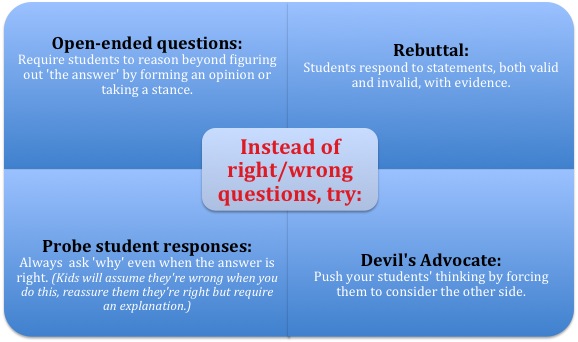
Check for Understanding Graphic

Example:  In math class, instead of solving a problem, give two problems and ask students to explain which problem is harder.  This requires everyone to solve the problem and allows for more advanced thinkers to ponder further, plus it allows you to discover where the misunderstandings lie for those who are struggling.  Another version of this may ask students to create a third problem that is similar to the original two problems, allowing the students to find commonalities and then create something new that fits into the group.

4.    Wait for it!

Slow down!  Too often we are in such a hurry to finish a lesson that we don’t check to make sure the intended learning is happening.  After asking a question, just wait, give students time to think and process.  ‘Wait time’ often comes with uncomfortable pauses but it also comes with increased participation and understanding.  If too many pauses feel uncomfortable, consider a think-pair-share followed by a journal entry routine.  Allow students a few seconds to think, then a few more to pair with a neighbor, and enough time to write a sentence or two in a special section of their notebooks.  Students can write their thinking or perhaps what they learned from their partner.  Then share, everyone should be able to share either their own answer or their neighbor’s.  The biggest issue with any ‘wait time’ strategy is the amount of time it takes, so plan ahead and budget appropriately while also picking your spots, find your balance.

 5.  Before anything else…”

Preparation is the key to success.  All of the strategies mentioned require time and effort in preparation.  Teachers who have been employing these strategies for many years need not plan much further in advance than a few minutes or even seconds.  However, if these are new to you, sit down beforehand and plan.  Look for places to include these strategies in your current lessons, plan time to have conversations with your students about their learning.  The amount of time and energy that one well thought out lesson may take is dwarfed by the incredible increases in learning gained from a prepared teacher!

“As educators, we are responsible for learning, not teaching.”

Truer words, perhaps, have never been spoken.  The job we do every day with our students comes with the wrong name, teacher.  As a verb, “teaching” is a one-way activity whereby the sage with all the knowledge explains, demonstrates, and passes all of their knowledge onto their students.  BUT, that’s not how it works is it?  No, we’re facilitators, leaders of exploration, motivational speakers; we’re lots of things and yes, we occasionally ‘teach’ as well.

Anyway, I don’t want to take up your time ranting about your job title but rather asking you a question, the very same question asked by Edutopia blogger and educational coach, Elena Aguilar…”Do you check for understanding often enough with students?”  Jumping back to that great quote (also from Aguilar), it’s not about imparting your knowledge on your students but rather facilitating their learning.  Often times as teachers we can feel rushed to complete a lesson or unit because we have to get to the next one, just so we can finish everything we want to cover for the year.  That’s a normal feeling but is it worth it, what about quality over quantity?!  So, I’d like to ask two of my own questions, ‘How do you know your students are actually learning what you want them to?’  and ‘When your students leave the classroom, do you know how well each of your students understood the day’s objective?’  These two questions are essential, if you can’t (honestly) answer in a way that is truly positive then perhaps it’s worth rethinking your strategies for checking for understanding and student learning.  It’s not okay to rely on a quiz every 8 days to tell you which students are getting it and where the gaps in learning happen to be.  Frequent and accurate checks for understanding are the key to ensuring learning in our classrooms.  Have a look at Elena Aguilar’s blog post regarding checks for understanding as well as the attached PDF with techniques for quick and easy formative assessment (from Wiggins and McTighe, Understanding By Design, via http://www.christina.k12.de.us/).  No matter how confident you are with this aspect of teaching it never hurts to try something new 🙂

Brains are weird and amazing things!

For those of us who aren’t health teachers, perhaps there are some things that we tend to forget about our young charges and their brains. Recently the health teachers have had the distinct and utter pleasure of working with our kids in units about puberty, drugs and alcohol, and sex ed among others. The sex ed and drugs/alcohol discussions are offered for our seventh and eighth graders but it’s the sixth graders that I think really pose the most interesting study in the middle school age group. We’ve all seen the wide range within our current sixth grade class; it seems even broader than in years past. I think the puberty unit can be a good reminder for a lot of us; these kids are still very young in both maturity and developmental levels.
So what does this mean for us as educators? Well, I would suggest that as teachers, who are responsible for over 100 students in the course of a two-day cycle, that we have a responsibility to constantly keep one important fact in mind: A lot of our middle school students, especially the younger boys, are still developing many of the crucial brain functions that will allow them to be successful as they grow older. I could write on this all day but to be honest you should take the next few minutes and check out this article from the American Psychological Association (APA)…it’s a great reminder of the challenge we face teaching middle schoolers!! (At least check out page one and two, they are brilliant!) And, just in case you don’t want to follow my advice and click the link, then you should at least see this quote…these aren’t just my two cents today, this is some powerful stuff 🙂
“Just because you have a classroom full of students who are about the same age doesn’t mean they are equally ready to learn a particular topic, concept, skill or idea. It is important for teachers and parents to understand that maturation of the brain influences learning readiness. For teachers, this is especially important when designing lessons and selecting which strategies to use.”

Are you having fun?

I love finding good quotes, they are short and to the point (to be fair they are often ambiguous and generalized as well) and they usually come with a certain message.  Recently I was cruising the Twitter-sphere, as I try to do once or twice a week, following my favorite hashtag #edchat.  I saw a tweet that said,


This got me thinking, how many of our teachers are having fun while they are teaching?  Now, I know that there can’t be a person alive who is always having fun, it’s just not possible, we’re human.  BUT, what about the majority of the time?  Last week I wrote about our kids being bored in class, what about you?  No one wants you to teach to a certain style, in fact, I want to encourage you to show yourself in the way you teach.  Everyone here is awesome, fun, and full of passion…don’t be afraid to show it in the classroom!!  I know that we’re all here because we love what we do and we enjoy the kids, teaching, learning, seeing those lightbulbs go on over kids heads; but what are we doing to make sure that we’re having fun?  I’d love to hear back from people this week about things they try in their classrooms to make it fun for themselves…maybe it’s a simple game for the last two minutes, or a certain style of presentations, or perhaps something you imbed into every lesson.  Anything and everything is welcome!!!  Please share and I will share out things I hear back!

“It’s Not Attention Deficit — I’m Just Not Listening!”

This quote comes from a blog post I read recently, the author saw this printed on a teenager’s t-shirt…It hits home hard for me.  I know as an adult that I have a hard time reining in my focus for certain topics or speakers; then I think about our students having to sit in a classroom for 90 minutes at a time, four times a day, and I am impressed at the fact that they can manage at all, let alone be as successful as they are.  But what about those kids who aren’t managing it successfully, why aren’t they choosing to listen?  Researcher Linda Stone came up with the term “continuous partial attention” (CPA) to explain the phenomenon of today’s connected culture.  We are constantly on call, 24/7, with smartphones vibrating in our pocket, e-mails sent to our phone, and all the other distractions.  So what can we do to help our students free themselves from this CPA for 90 minutes at a time?  One potential solution provided by the author was simple, be less boring as teachers.  When I was in school I know it was waaaay more boring than it is now, I mean I walk into classes at our school that are 100 times more engaging than anything I ever sat through!!  However, it seems that kids in the CPA culture are still bored in classes.  What can we do to help our students become more present in our classrooms?  Goal-setting and asking for (and listening to) student feedback are two important strategies suggested in the later half of this blog post.  Have a look and let me know what you think…our 21st century learners are begging you 🙂

Effective Use of Open-Ended Questions

In our most recent SST meeting we took a close look at some of our students who we worry may have slipped through the cracks.  As part of this conversation we thought long and hard about some of the reasons as to why these kids may have been overlooked as ‘struggling’ students.  One point that was raised is that perhaps the “checks for understanding” that are happening in classes aren’t truly checking for understanding.  How often do you ask a question that could be answered with a one word response?  Is it a ‘yes’ or ‘no’ answer?  The use of open-ended questions in the classroom is a practice that sounds a lot easier in theory than it really is to implement.  Kids take time to process and answer, sometimes the answers are repetitive or seem like ramblings, often times we fell like we need to rush to get through the day’s lesson and we don’t have time for long-winded answers.  All of these things are common feelings to experience when pushing students to answer open-ended questions.  However, forcing kids to process their thoughts through a think-pair-share or by writing their answers and then sharing ensures that kids don’t just hitch-hike their way through class and slip through the cracks.  In this write-up from the Marshall Memo you will find a more in-depth discussion of how to use open-ended questions as well as the importance of doing so in the classroom.  This article was written in relation to elementary classrooms but there isn’t one word of it that doesn’t apply to our middle school classes…enjoy and let me know what you think.

Living Life-Lessons to the Fullest

Wow, I love that we just got back from a break and next week we’re already back off again!!  This is perhaps, other than summer, the best time of year…and…full of the most learning for our students!  I know, I know, they aren’t sitting in your classrooms but that doesn’t mean they aren’t still learning.  I don’t think I have to tell any of you where I am going with this but I will any way 🙂  Life lessons, travel, getting out into the world and experiencing all sorts of awesomeness!!

Our students have some of the coolest lives possible; the stories I heard from their winter breaks alone are incredible.  Sixth graders bungee jumping, scuba diving in exotic locations, traveling to new countries, and even the kids who stayed in Shanghai have great stories of the fun they had.  I know a lot of us are great about documenting and reflecting on our experiences, whether in a blog, on Facebook, or an old-fashioned journal.  However, what about our students?  What do they do to record these life-lessons, these experiences that will shape their lives?  I’m asking you today to simply encourage your students to record their awesome experiences.  When we return from break on February 10th we have a Dragon Time dedicated to e-Portfolios but as you know there won’t be much to do during that time…so, please have your kids create a new tab/page/link/section of their portfolio for journaling and recording their experiences.  They don’t have to travel to far away places to journal their lives, nor do they have to talk about what happened just recently but they should have a place to document their lives and what better place than on their ePortfolio?!?  Please help your students begin to record these experiences, after all they are waaaay more valuable than just two cents 🙂

Also, check out this page “Living Life to the Fullest” it has 30 ways to do just that and #1 is “Act Like a Kid!!”

Teaching Students to be Proud of Themselves

As report cards go out and students see their marks for classes I worry a lot that students and parents (and perhaps us sometimes) put too much value into the grades on those papers.  I don’t think these kids really believe that the only reason they did all that work was to get one number printed out about them at the end of the semester.  However, at this time of year it certainly seems that way.  What are kids (and/or their  parents) so proud or disappointed about when they look at those reports?  Is it the number grade or is it the realization of how much they learned throughout the semester?  And what’s our role in that perception?  When students are assigned work, what message are we sending about the value of the work…is it about the learning or getting a good grade?  When kids have missing work…what do we threaten, lower grades or loss of learning opportunity?  We should think carefully about the message we are sending to our students.  We all want them to value what it is we are teaching but what incentive are we giving them?  Likewise, when they have done well how are we praising them?  When I was first starting out as a teacher I came across a way of speaking to my students (I can’t remember if I read it, heard it, or was told) and I’ve tried to internalize one phrase ever since, “You should be proud of yourself!”  Check out this article about helping students feel proud about themselves.  Our students need to learn that school is about the learning and that they should be proud of themselves for all the hard work they put into that learning!!  Enjoy your holidays, you all deserve it…but hey, that’s just my two cents 😉

The Homework Monster

As the semester comes to a close and my, what the students are calling ‘naughty list’ (my list of students with missing work) grows, I’ve been thinking a lot about the work being assigned to our students.  For the most part I don’t chase kids for day-to-day homework assignments; in fact, almost all of what I am after is higher-stakes work such as projects, labs, or missing quizzes.  However, as I scan through the Power School/Grade Book I have begun to notice an overwhelming amount of missing ‘homework’ assignments…which has made me wonder, “Why are kids not completing their homework?”  I think the answer lies in two areas:  First of all, it seems that kids don’t understand the intended function of homework as practice.  Rick Wormeli, a name we’re familiar with at this point, goes so far in his classroom as to call homework “practice” and refers to it as such instead of using the word “homework.”  However, this isn’t just about what you call it; rather it is also about how you use it, is it valuable or is it busy work?  The second reason is, I believe, that our students begin to think that their teachers don’t value the work and therefore why should they?!?!  Check out this blog post…it is from a charter school I used to work for and is written by a friend and former colleague of mine, I think it speaks to this second point very well.  Finally, I’d like to hear your thoughts on these two ideas, especially as we start the second semester…I’m working to develop a plan for a number of our less organized students and your two cents will go a long way!